
 EN
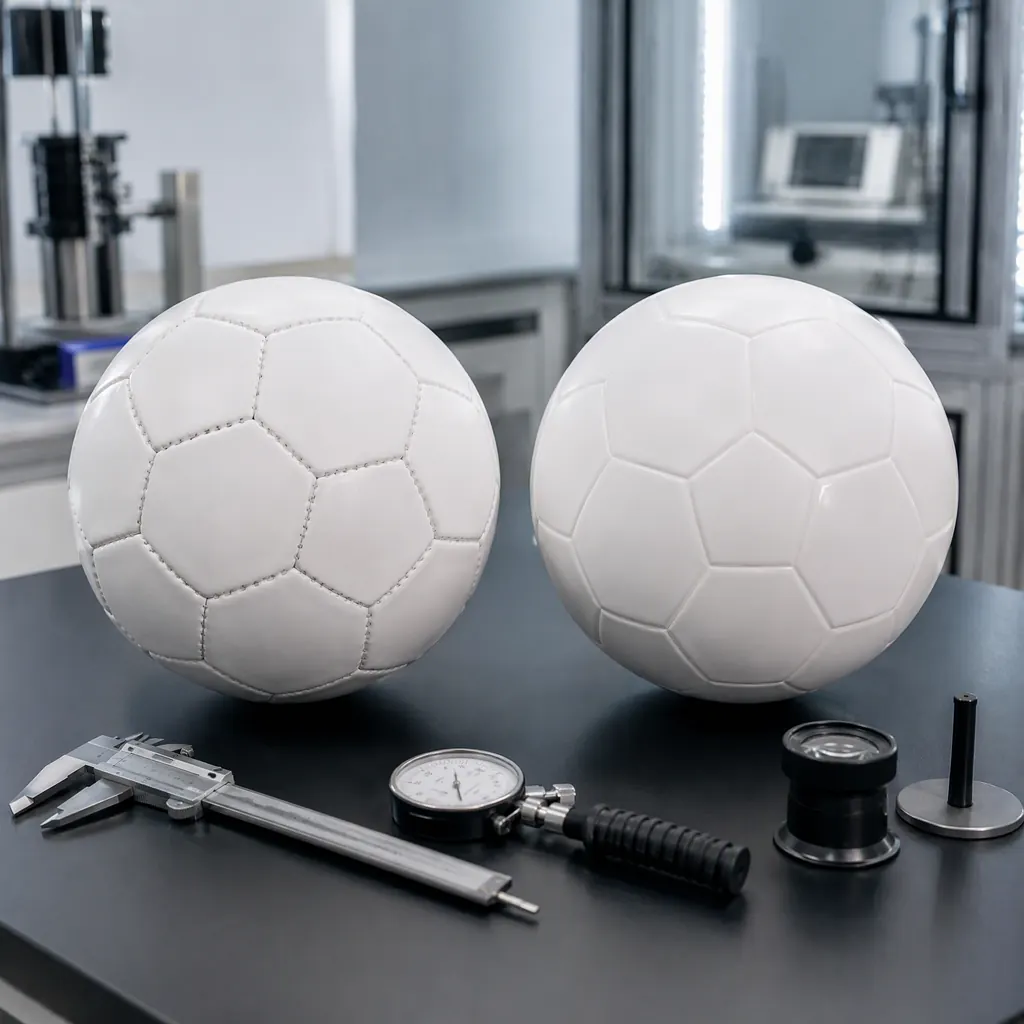
Stitched vs. Thermal Bonded Soccer Balls
For a soccer ball buyer, soccer ball construction is more than a technical detail. It affects the ball’s response, durability, water management, appearance, repair profile, and production cost. The two approaches most often compared in commercial sourcing are a stitched soccer ball and a thermal bonded soccer ball. Both can produce dependable products when the materials, process controls, and specification are appropriate. Neither method should be treated as a universal answer for every market.
A factory quotation that says “stitched” or “thermal bonded” is only the starting point. A procurement team still needs to understand the panel material, lining system, bladder, adhesive or thread, finishing process, and inspection plan. This guide explains the practical differences in soccer ball manufacturing so importers, sports brands, distributors, schools, and club-supply businesses can make a better-informed sourcing decision.
What stitched construction means
In a stitched soccer ball, panels are joined with thread after cutting and preparation. The factory may use machine stitching, hand stitching, or a combination of processes depending on the product level and construction design. The thread pattern, seam allowance, stitch tension, and operator technique all influence the final result.
Stitching is a flexible manufacturing route within soccer ball construction. For buyers comparing soccer ball construction, it can accommodate a broad range of panel shapes and materials, and it allows a factory to make adjustments without redesigning a complete molding system. A stitched ball may also be easier to inspect visually because seams, thread tension, and panel alignment are directly visible during production.
For buyers, the important question is not simply whether the ball is stitched. Ask what thread is used, how the seams are reinforced, whether the product has a multi-layer lining, and how the factory controls seam consistency. A sound stitched construction should have even seam lines, secure thread ends, controlled panel tension, and no loose or skipped stitches.
What thermal bonding means
In a thermal bonded soccer ball, prepared panels are joined with heat, pressure, and a bonding layer or compatible surface treatment. The process is often associated with a clean exterior because there is no exposed thread along the panel joints. The factory must control temperature, pressure, dwell time, panel positioning, and cooling conditions to keep the ball round and the seams stable.
Thermal bonding is another soccer ball construction route. In a soccer ball construction review, it can support a more consistent surface profile when the factory has suitable equipment and an established process. A smooth seam structure may help reduce areas that collect moisture or dirt. It can also give a modern appearance that suits performance-focused or premium product lines.
However, thermal bonding is not automatically superior. Bond strength depends on material compatibility, adhesive quality, surface preparation, and process discipline. If a panel is contaminated, the heating cycle is inconsistent, or the bladder and lining are not properly balanced, the finished ball may develop seam separation or shape variation. Buyers should evaluate process capability, not just the construction label.
Performance considerations for different markets
Stitched balls often provide a familiar feel and can be a practical choice for training, school programs, promotional distribution, and markets where repairability and cost control matter. The seam structure can offer a defined tactile response, although the exact feel depends heavily on the cover texture and internal lining.
A thermal bonded soccer ball may be attractive for match-inspired products, technical training ranges, and premium retail programs that prioritize a clean surface and controlled water resistance. A bonded seam can support a consistent exterior, but the product still requires testing under realistic use. A ball that looks refined in a showroom may perform differently on wet grass, artificial turf, or abrasive hard ground.
Consider the selling environment before choosing. A school supplier may value durability across varied users and straightforward cost management. A sports brand may place more weight on visual consistency, touch, and brand positioning. A club buyer may need repeatable specifications across multiple production batches. The right method is the one that fits the complete use case.
Durability and service life
Durability in soccer ball construction comes from the whole system rather than one feature. When reviewing soccer ball construction, cover thickness, foam backing, lining layers, bladder quality, seam geometry, and inflation practice all contribute. A well-made stitched ball can last through demanding training, while a poorly bonded ball can fail prematurely. The reverse is also possible.
For a stitched soccer ball, inspect thread abrasion, seam opening, thread tension, and the security of seam starts and ends. For a thermal bonded soccer ball, inspect bond continuity, edge lifting, bubbles, wrinkles, and separation after repeated inflation and use simulation. Ask the factory to provide a defined test method instead of relying on a general statement such as “high durability.”
Environmental exposure also matters. Heat, humidity, ultraviolet light, water, and storage pressure can affect synthetic covers and bonding systems. If the product will be shipped through humid climates or stored in non-climate-controlled facilities, include conditioning and post-conditioning checks in the approval plan.
Quality-control checklist for construction choice
- Confirm the panel material, backing layers, bladder type, and intended playing surface.
- Review a production sample, not only a digital rendering or catalog image.
- Measure roundness, weight consistency, circumference, and rebound against an agreed specification.
- Check seam appearance, panel alignment, surface finish, valve installation, and logo registration.
- Perform inflation retention and repeated inflation checks using a documented procedure.
- Test wet handling and surface abrasion when the product will face outdoor use.
- Set acceptable limits for cosmetic issues and define how nonconforming units are handled.
Sampling should represent the actual production run. A factory may produce a good development sample but struggle to repeat the result when orders are larger or several colors are running at once. A buyer can reduce this risk by approving a sealed reference sample, a technical specification, and a pre-shipment inspection plan together.
Cost, customization, and lead-time questions
Stitched construction may offer more flexibility for smaller customized orders because the tooling requirements can be less demanding. Thermal bonding can become efficient when the design, panel set, and process are stable, but setup and equipment requirements may influence minimum order quantities. Costs vary by material, labor, finish, packaging, testing, and the complexity of the artwork.
Customization should include more than printed graphics. Ask whether a change in cover texture, panel color, lining, bladder, or seam treatment affects the approved performance. Artwork can also behave differently on a curved bonded surface compared with a stitched panel set. Require a physical pre-production sample when appearance is central to the launch.
How to make the final decision
Start with the end user, playing environment, target price, brand position, and expected volume. Then compare stitched and thermal bonded samples using the same bladder, cover category, and test conditions where possible. This soccer ball construction comparison isolates the seam effect and prevents a material difference from being mistaken for a construction difference. Record the soccer ball construction choice in the final purchase specification.
For many B2B programs, a portfolio approach is sensible. A stitched model can serve value-oriented training channels, while a thermal bonded model can support a premium range. Document the reason for each choice so future orders remain consistent. When reviewing a supplier, pay attention to how clearly the factory explains its process controls and corrective-action practices. Transparent communication is a useful indicator of manufacturing maturity.
Stitching and thermal bonding are both valid technologies in soccer ball manufacturing. The better procurement decision comes from matching soccer ball construction to use, validating the full material system, and controlling repeatability from sample approval through shipment. A clear specification and disciplined inspection plan will usually matter more than a construction label used in isolation.